The Hidden Cost of High Attrition in Industrial Hiring
Industrial companies often focus heavily on production targets, project deadlines, manpower requirements and operational costs. But one cost can remain hidden for a long time: employee attrition.
When skilled workers repeatedly leave a factory, construction site, fabrication project or industrial facility, the company does not simply lose an employee. It can also lose productivity, project knowledge, training investment, operational continuity and valuable time.
This is why industrial workforce attrition has become an important issue for companies that depend on skilled technicians, welders, fabricators, fitters, electricians, maintenance workers, supervisors and other technical professionals.
High turnover can increase recruitment expenses while also creating pressure on the workers who remain.
Understanding the real manpower turnover cost is therefore essential for companies that want to build a stable and productive industrial workforce.
What Is Industrial Workforce Attrition?
Industrial workforce attrition refers to the rate at which employees leave an industrial organization and need to be replaced.
Attrition can happen for several reasons. Workers may leave because of better salary opportunities, project completion, poor working conditions, limited career growth, relocation, inadequate accommodation, lack of recognition or better opportunities with another employer.
In industrial environments, the impact can be significant because many positions require practical skills and project-specific experience.
Replacing a general employee may be relatively straightforward, but replacing an experienced pipe fitter, welder, electrician, instrumentation technician, QA/QC inspector or maintenance professional can take considerably more time.
For companies operating on strict project schedules, this creates an operational challenge.
Why Is Industrial Workforce Attrition a Serious Problem?
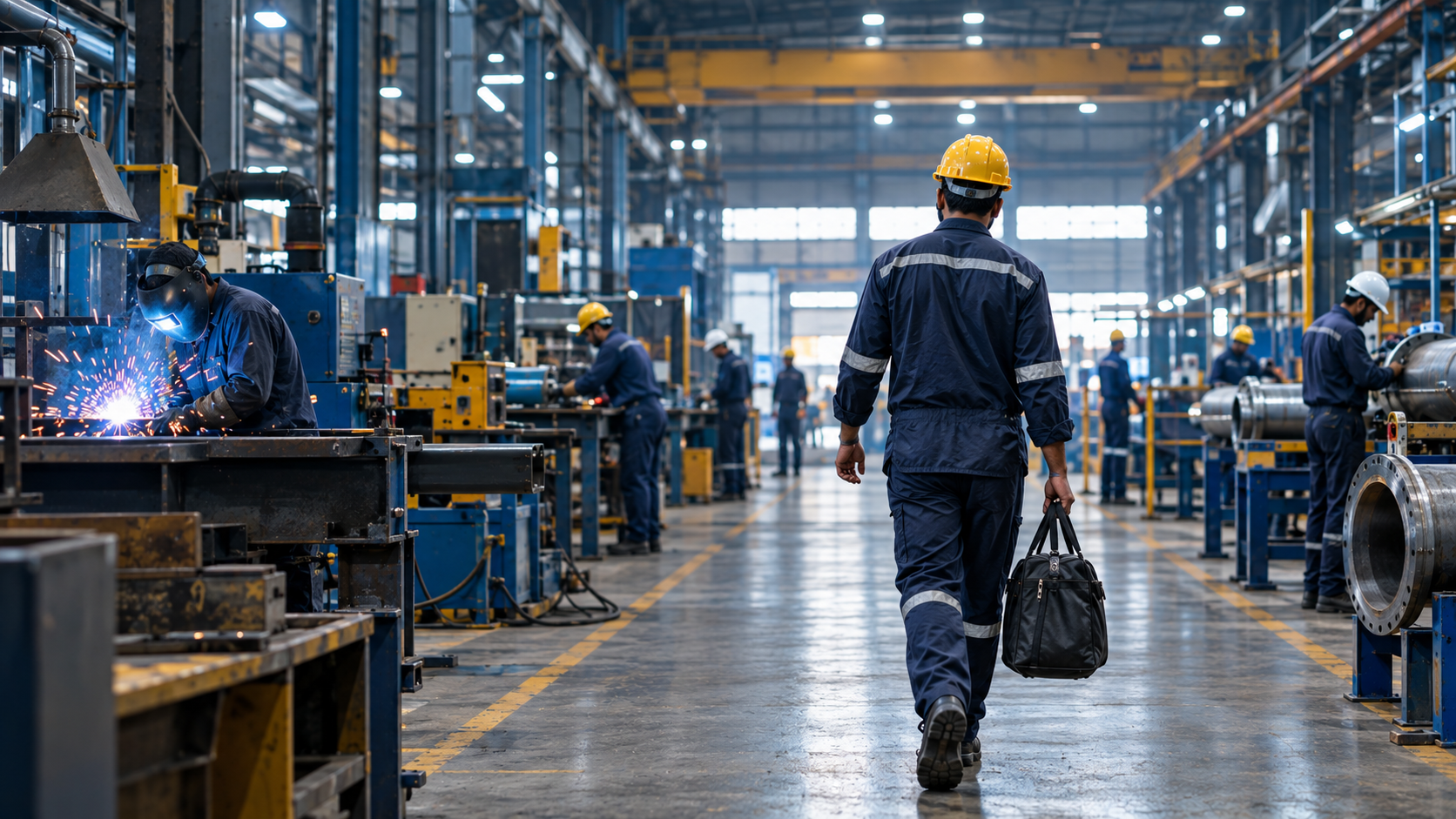
Industrial operations depend on people who understand equipment, processes, safety procedures and project requirements.
When experienced workers leave, companies can lose more than headcount.
They may also lose:
Practical project knowledge
Experience with specific equipment
Understanding of site procedures
Team coordination
Production efficiency
Training investment
Workplace familiarity
Customer confidence
A company may quickly find another worker on paper, but finding someone with the same combination of skills, experience and project knowledge can be much harder.
This is one reason why manpower turnover cost can be much higher than the salary of the employee who leaves.
The Hidden Costs of High Manpower Turnover

The most visible cost of attrition is recruitment. However, the actual cost can extend across multiple areas of an industrial business.
Recruitment Costs
Every time an employee leaves, the company may need to spend money and staff time on sourcing candidates, screening applications, conducting interviews and completing documentation.
For specialized industrial roles, recruitment can take even longer because companies need candidates with specific technical experience.
Training and Onboarding Costs
New employees need time to understand company procedures, safety requirements, equipment, reporting systems and project expectations.
Even experienced workers may require site-specific orientation.
During this period, the employee may not operate at the same productivity level as an experienced team member.
Productivity Loss
A vacant position can affect the entire team.
If one skilled worker leaves, other workers may have to take on additional responsibilities. This can reduce efficiency and increase pressure on the existing workforce.
For project-based businesses, even a small productivity reduction can contribute to schedule pressure.
Overtime Costs
When there are not enough workers available, companies may depend on overtime to maintain production.
This can increase labor expenses while also contributing to worker fatigue.
Over time, excessive workload can itself become a factor contributing to employee turnover.
Project Delays
Industrial projects often operate according to schedules involving multiple teams and contractors.
If a critical position remains vacant, other activities may also be affected.
For example, a shortage of qualified welders or pipe fitters can affect fabrication and installation activities, potentially creating delays in subsequent work.
Companies involved in fabrication can learn more about this area through their dedicated fabrication services page.
Loss of Experience
Experienced employees often know how to solve practical problems quickly.
When they leave, their knowledge leaves with them unless the organization has effective documentation and knowledge-transfer processes.
This hidden loss is difficult to calculate but can have a long-term effect on operational performance.
How High Attrition Affects Industrial Projects
High attrition can create a cycle that becomes increasingly difficult for companies to manage.
A worker leaves.
The company starts recruitment.
The position remains vacant.
Existing workers take on additional responsibilities.
Work pressure increases.
Productivity can decline.
The company hires a replacement.
The replacement requires onboarding and training.
The team eventually becomes stable again.
If another employee leaves during this process, the cycle begins again.
This is why companies should not look at attrition only as an HR issue. In industrial businesses, workforce stability can directly affect operations and project execution.
For businesses involved in industrial projects, manpower planning is closely connected with project execution support.
Why Do Factory Workers Leave?
There is no single reason behind factory worker attrition.
Different workers may leave for different reasons, but several factors commonly influence retention.
Better Salary Opportunities
Skilled workers often receive offers from multiple companies.
If another employer offers better compensation, overtime opportunities, accommodation or other benefits, workers may consider changing jobs.
Limited Career Growth
Workers may leave when they do not see a clear path toward higher responsibility.
For example, a technician may want opportunities to become a senior technician, supervisor or specialist.
Without career development, experienced workers may search for opportunities elsewhere.
Poor Working Conditions
Industrial work can involve demanding environments.
Shift schedules, site conditions, accommodation, transportation, safety practices and workplace culture can all influence employee satisfaction.
Lack of Recognition
Workers who consistently perform well may expect recognition for their contribution.
When employees feel that their work is not valued, their connection with the organization can weaken.
Unstable Project Employment
Some industrial workers move between projects because their previous project has ended.
Companies that provide clearer communication about project duration, future opportunities and workforce planning can create greater confidence among employees.
Delayed Payments or Poor Communication
Payment reliability is especially important for blue-collar workers.
Unclear salary structures, payment delays or poor communication about employment terms can quickly damage trust.
The Impact of Attrition on Skilled Manpower Availability
One of the biggest challenges associated with industrial workforce attrition is the loss of skilled manpower.
Industrial work frequently requires practical knowledge that cannot be developed overnight.
A welder may have years of experience working with different materials and welding processes.
A pipe fitter may understand drawings, measurements, alignment and installation requirements.
An electrician may have experience with industrial electrical systems.
A maintenance technician may understand the behavior of specific machinery.
Replacing such workers requires more than finding someone with a similar job title.
Companies need to evaluate actual skills, experience, certifications and project exposure.
This is why structured manpower sourcing and skill-based hiring can become important parts of workforce planning.
How to Reduce Factory Worker Attrition
Companies looking for ways to understand how to reduce factory worker attrition should start by identifying the reasons employees are leaving.
A simple retention strategy may include the following steps.
Understand Why Workers Leave
Companies should track employee exits and identify common patterns.
Exit interviews can help reveal whether employees are leaving because of compensation, working conditions, management, project uncertainty, transportation, accommodation or career opportunities.
Improve Communication
Workers should understand their responsibilities, salary structure, working hours, project duration and employment conditions before joining.
Clear communication reduces misunderstandings later.
Provide Growth Opportunities
Training and promotion opportunities can help experienced workers see a longer-term future within the organization.
Recognize Good Performance
Recognition does not always have to mean a major financial reward.
Certificates, promotions, performance incentives and appreciation can help workers feel valued.
Maintain Safe Working Conditions
Safety should be a fundamental part of industrial workforce management.
Workers are more likely to trust organizations that demonstrate a serious commitment to workplace safety.
Retention Strategies for Blue-Collar Workers
Effective retention strategies blue collar workers can respond to should focus on practical workplace needs.
Some important areas include:
Competitive and transparent compensation
Reliable salary payments
Safe working conditions
Proper accommodation where applicable
Transportation support for remote sites
Overtime clarity
Skill development
Career progression
Performance recognition
Respectful supervision
Clear project communication
Long-term workforce planning
Retention is not simply about keeping workers in a company.
It is about creating an environment where skilled employees have practical reasons to stay.
How Better Hiring Can Reduce Manpower Turnover
Hiring the right person for the right position can reduce the probability of early turnover.
For example, if a company hires a worker without properly understanding their technical experience, the employee may struggle with the actual job requirements.
This can create frustration for both the company and the worker.
A better hiring process should evaluate:
Technical skills
Relevant experience
Certifications
Previous project exposure
Safety knowledge
Job expectations
Location requirements
Shift requirements
Salary expectations
Skill-based hiring can help companies match workers with jobs that better fit their actual capabilities.
For industrial organizations requiring manpower for different projects, professional industrial manpower services can also support workforce planning and recruitment requirements.
The Role of Skill Verification in Industrial Hiring
A resume can provide useful information, but it may not always show the complete picture of a worker's practical ability.
Skill verification can help companies understand whether a candidate has the capabilities required for a particular position.
Depending on the role, verification may include:
Technical assessments
Certification checks
Experience verification
Practical skill tests
Previous project history
Safety knowledge
Role-specific interviews
A more structured evaluation process can help companies reduce mismatches between job requirements and worker capabilities.
This can also improve the chances of workers joining positions that match their skills and experience.
How Industrial Manpower Planning Can Improve Retention
Workforce planning should begin before a project reaches a critical manpower shortage.
Companies can forecast manpower requirements based on:
Upcoming projects
Required skills
Project duration
Workforce availability
Expected employee turnover
Seasonal demand
Production targets
Early planning gives companies more time to identify suitable workers.
It also reduces the pressure associated with last-minute hiring.
For industrial businesses involved in plant work, manpower planning can be particularly important because installation and maintenance activities often depend on teams with complementary skills.
Companies can also explore specialized plant installation services when planning manpower and project execution requirements.
Building a More Stable Industrial Workforce
Reducing attrition is not achieved through recruitment alone.
Companies need a complete workforce strategy.
That strategy can combine hiring, skill verification, training, safety, compensation, communication and career development.
A stable workforce can help companies maintain project knowledge and reduce repeated onboarding.
It can also make team coordination easier because experienced workers understand the organization's processes and expectations.
Over time, workforce stability can become an operational advantage.
How AM Industrial Supports Industrial Manpower Requirements
AM Industrial Fabrication & Projects focuses on industrial manpower, fabrication and project support requirements. You can learn more about the company and how it approaches industrial workforce planning.
Companies working on industrial projects often need access to skilled manpower for different stages of execution.
Depending on the project, requirements can include skilled workers, technical personnel, fabrication teams, installation support and project execution resources.
You can explore the industrial manpower services offered through AM Industrial or learn more about fabrication services and plant installation requirements.
For broader project requirements, companies can also explore project execution support, and industrial contractors can partner with AM Industrial directly for ongoing manpower needs.
The objective is to connect manpower requirements with practical industrial project needs while supporting better workforce planning.
The Bigger Picture: Why Workforce Retention Matters
Industrial growth depends not only on factories, machinery and investment.
It also depends on people who know how to operate, maintain, fabricate, install and manage industrial systems.
When experienced workers repeatedly leave, companies may face costs that are not immediately visible in their financial statements.
Recruitment expenses are only one part of the problem.
Training, onboarding, overtime, productivity loss, project delays and loss of practical knowledge can all contribute to the overall manpower turnover cost.
For this reason, industrial organizations should treat employee retention as part of operational planning rather than viewing it only as an HR responsibility.
Conclusion
High employee turnover can create a hidden financial and operational burden for industrial companies.
Industrial workforce attrition can increase recruitment requirements, training expenses, overtime pressure and productivity challenges while reducing the availability of experienced workers.
The solution begins with understanding why workers leave.
Companies can then improve hiring processes, verify skills, provide clear employment conditions, maintain safe workplaces, support career development and build stronger communication with their workforce.
For organizations looking at how to reduce factory worker attrition, the goal should not simply be to hire more workers.
The goal should be to build a workforce that is properly matched to the job, supported by the organization and given practical reasons to stay.
A stable industrial workforce can help companies protect experience, improve continuity and manage projects more effectively. Companies can also discuss their manpower requirement directly with an established industrial partner.
Frequently Asked Questions
What is industrial workforce attrition?
Industrial workforce attrition refers to employees leaving an industrial organization and needing to be replaced. It can include skilled workers, technicians, operators, supervisors and other industrial personnel.
What is manpower turnover cost?
Manpower turnover cost is the total cost associated with replacing employees who leave. It can include recruitment, hiring, onboarding, training, overtime, productivity losses and other operational expenses.
Why do factory workers leave their jobs?
Factory workers may leave because of better salary opportunities, poor working conditions, limited career growth, project uncertainty, workplace issues, relocation or better opportunities with another employer.
How can companies reduce factory worker attrition?
Companies can reduce attrition by improving hiring, compensation transparency, workplace safety, communication, training, career development, recognition and workforce planning.
What are effective retention strategies for blue-collar workers?
Useful retention strategies blue collar workers may value include reliable payments, safe working conditions, fair compensation, accommodation or transportation support where applicable, skill development, recognition and career opportunities.
Can better hiring reduce employee turnover in factories?
Better hiring can help reduce turnover when companies accurately match workers' skills, experience and expectations with the actual requirements of the job.
Why is skill verification important in industrial hiring?
Skill verification can help companies understand whether a worker has the technical capabilities required for a specific position, reducing the risk of hiring candidates whose experience does not match the job requirements.
How does manpower planning help industrial companies?
Manpower planning helps companies anticipate workforce requirements before projects begin. It can reduce last-minute recruitment pressure and help ensure that the required skills are available when needed.
Final Takeaway
The real cost of high attrition is much larger than replacing an employee.
For industrial companies, workforce turnover can affect productivity, project schedules, recruitment expenses, team stability and valuable technical knowledge.
A combination of better hiring, skill verification, workforce planning and practical retention strategies can help companies build a more stable industrial workforce.
In an industry where skilled people are essential to getting projects completed safely and efficiently, retaining the right workforce can be an important part of long-term operational planning.