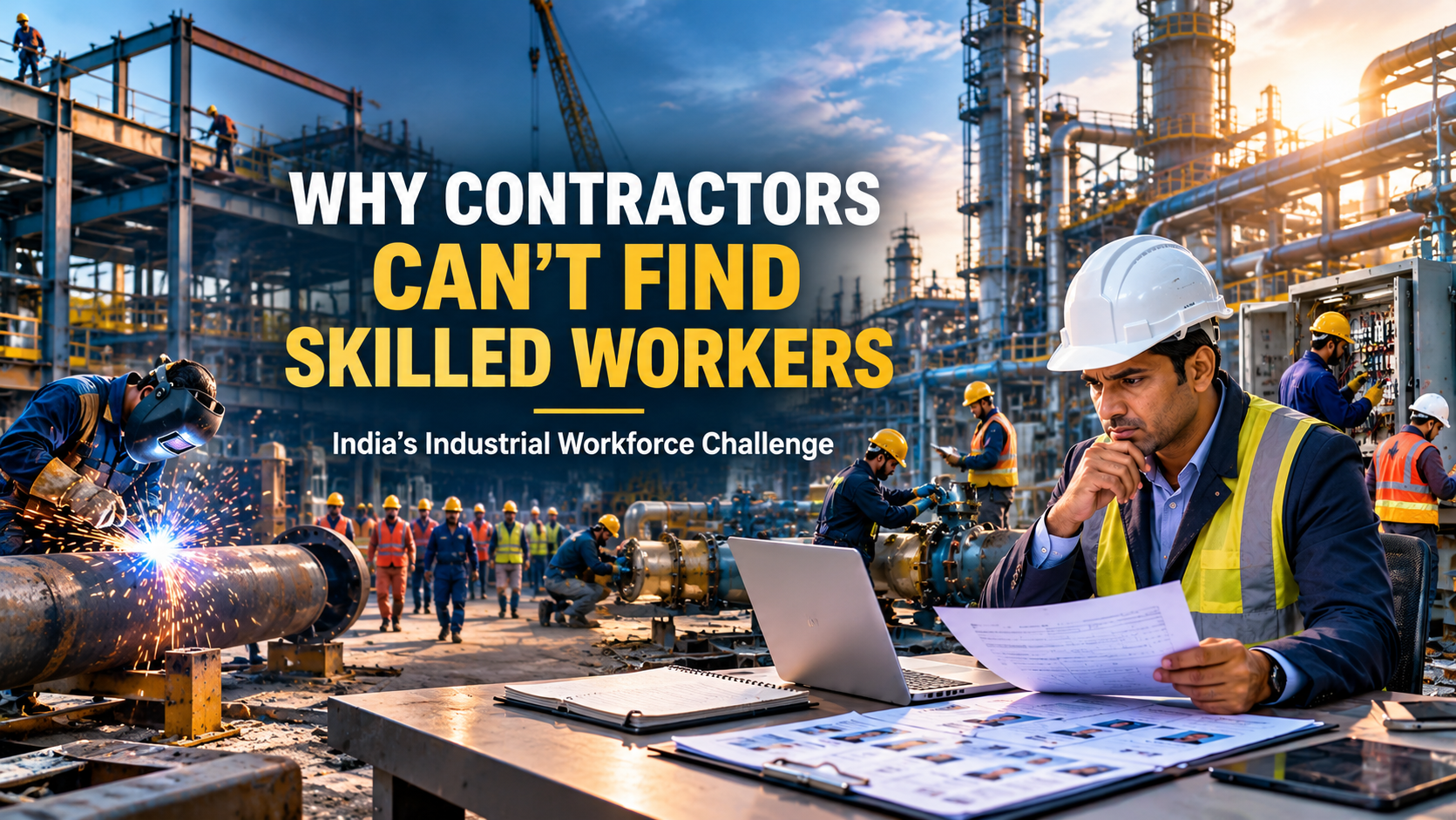
Why Indian Contractors Can't Find Skilled Workers Even When Manpower Is Abundant
India has a large workforce, yet many industrial contractors continue to face difficulty finding workers with the right technical skills.
A contractor may receive hundreds of applications for a project and still struggle to find an experienced welder, electrician, pipe fitter, fabricator, maintenance technician or other skilled professional who can immediately join and perform the required work.
This creates an important question:
If manpower is abundant, why are contractors still facing a skilled labour shortage?
The answer is more complicated than simply saying there are not enough workers.
The real challenge is often the gap between available manpower and job-ready skilled manpower.
For contractors working on industrial plants, fabrication projects, construction sites, maintenance shutdowns and installation projects, this gap can create recruitment delays, higher manpower costs and pressure on project schedules.
This article examines the reasons behind the skilled labour shortage India contractors are experiencing and explains why the industrial contractor hiring problem is becoming increasingly important.
What Is the Skilled Labour Shortage in India?
A skilled labour shortage does not necessarily mean that there are no workers available.
It can mean that contractors cannot find enough workers who meet the specific requirements of a project.
For example, a contractor may need:
Experienced pipe welders
Structural welders
Pipe fitters
Industrial electricians
Instrumentation technicians
Mechanical fitters
Maintenance technicians
Fabricators
QA/QC professionals
Safety personnel
Skilled supervisors
There may be many people looking for work, but only a smaller number may have the required combination of practical experience, technical knowledge, certifications, safety awareness and immediate availability.
This is the difference between manpower availability and skilled manpower availability.
Why Are Contractors Struggling to Find Skilled Workers?
The industrial contractor hiring problem is influenced by several factors.
Skill and Job Requirements Do Not Always Match
One of the biggest challenges is the mismatch between what contractors need and what workers can actually perform.
A job description may require experience in a particular welding process, material, equipment or industrial environment.
A worker may have the job title "welder" but may not have experience with the specific work required on the project.
The same issue can happen with electricians, fitters, technicians and fabricators.
Contractors therefore need to evaluate actual capabilities rather than relying only on job titles.
Experience Matters More Than Headcount
Industrial work often depends heavily on practical experience.
An experienced worker may understand drawings, measurements, equipment, tools, safety procedures and site coordination because they have already worked on similar projects.
A newly trained worker may have basic technical knowledge but still require supervision and practical exposure.
For time-sensitive industrial projects, contractors often need workers who can become productive quickly.
Skilled Workers Are Not Always Available Where Projects Are Located
Industrial projects are frequently located away from major cities.
Factories, plants, construction sites and infrastructure projects can be located in industrial zones, smaller cities or remote areas.
A skilled worker may be available in one location but unwilling or unable to relocate to another project.
This creates a geographical mismatch.
Contractors may therefore have access to a large labour market while still struggling to fill a particular project requirement.
Workers Move Between Projects
Industrial workers often follow project opportunities.
A skilled welder or electrician may already be committed to another contractor, shutdown project or construction site.
When a new project begins, contractors may need manpower at the same time as several other companies.
This can create short-term competition for experienced workers.
Why Contractors Can't Find Welders and Electricians
The question "why contractors can't find welders electricians" has a practical explanation.
These jobs require specific technical capabilities.
Welders
Different projects may require different welding skills.
Requirements can vary according to:
Welding process
Material
Pipe size
Position
Thickness
Project standards
Industry
Required certification
Quality requirements
Therefore, finding someone who can weld is not necessarily the same as finding a welder who meets a particular project's requirements.
Electricians
Industrial electricians may need experience with equipment and systems that differ significantly from residential electrical work.
Depending on the project, contractors may require experience with industrial panels, motors, cable installation, control systems, maintenance or plant electrical infrastructure.
Again, the challenge is not simply the number of electricians available.
It is finding electricians with the right experience for the job.
The Difference Between Manpower Availability and Skill Availability
This distinction is central to understanding the skilled labour shortage India contractors face.
Imagine a contractor needs 30 skilled workers for a fabrication project.
There may be 300 workers available in the broader labour market.
However, if only 40 have the required experience and only 15 are available to join immediately, the contractor still has a serious manpower problem.
The issue is therefore not necessarily a shortage of people.
It is a shortage of the right people at the right time and in the right location.
This is one of the most important challenges behind industrial contractor hiring.
The Role of Skill Verification
One way contractors can improve hiring is through skill verification.
Instead of evaluating workers only through resumes or verbal claims, companies can assess:
Practical experience
Technical skills
Certifications
Previous project experience
Safety knowledge
Job-specific capabilities
Availability
Location
Relevant references
Skill verification can make it easier to distinguish between general manpower and job-ready skilled manpower.
It can also reduce the risk of hiring a worker whose actual capabilities do not match the project requirements.
How the Industrial Contractor Hiring Problem Affects Projects
Difficulty finding skilled workers can create several operational challenges.
Project Delays
If a contractor cannot assemble the required team on time, project activities may start late.
A shortage of one critical skill can sometimes affect several connected activities.
Higher Recruitment Costs
When contractors urgently need workers, they may need to spend more time and resources on sourcing candidates.
Last-minute recruitment can be more expensive than planned workforce hiring.
Increased Overtime
If there are not enough workers available, existing employees may have to work additional hours.
This can increase labour costs and potentially contribute to worker fatigue.
Lower Productivity
A worker who needs extensive supervision may not deliver the same productivity as an experienced professional.
This can place additional pressure on supervisors and experienced workers.
Quality Challenges
Industrial projects often require consistent workmanship.
When contractors are forced to fill positions quickly without sufficient skill verification, quality control can become more difficult.
Safety Risks
Industrial environments require workers to understand safety procedures and workplace hazards.
Technical skill and safety awareness are both important when selecting workers for industrial projects.
The Skilled Worker Crisis in India 2026
The skilled worker crisis India 2026 can be understood as a combination of workforce growth, changing industrial requirements and the increasing need for specialized technical capabilities.
Manufacturing, infrastructure, fabrication, plant maintenance and industrial construction can require workers who understand both traditional technical skills and modern workplace requirements.
Technology is also changing the nature of industrial work.
Workers increasingly need to understand modern equipment, digital processes, documentation, safety standards and quality systems in addition to their core trade skills.
This means that contractors may increasingly compete for workers who combine practical experience with updated technical knowledge.
Why Traditional Hiring Methods Are Not Always Enough
Traditional hiring often relies on:
Referrals
Local labour networks
Contractors
Job advertisements
Phone calls
Informal worker groups
These methods can still be useful, but they may not provide enough structured information about a worker.
A contractor may know that someone is a "fitter," but may not know:
Which projects they worked on
How many years of relevant experience they have
Which equipment they have handled
Which certifications they hold
Whether they are currently available
What type of work they specialize in
A structured worker profile can make this information easier to evaluate.
Digital Platforms Can Improve Skilled Worker Hiring
Digital workforce platforms can help bring more structure to industrial recruitment.
A useful platform can allow workers to create professional profiles containing:
Skills
Experience
Certifications
Project history
Location
Availability
Job preferences
Companies and contractors can then search for workers based on actual requirements.
This can make the recruitment process more targeted.
For contractors managing multiple projects, digital hiring can also make it easier to maintain a database of potential workers rather than starting the recruitment process from zero every time a project begins.
How Contractors Can Improve Skilled Worker Recruitment
Contractors looking to reduce their hiring problems can take several practical steps.
Define the Exact Skill Requirement
Instead of simply asking for "10 welders," define the requirement more precisely.
For example:
Welding process
Material experience
Required certification
Years of relevant experience
Project type
Location
Joining timeline
The more specific the requirement, the easier it becomes to identify suitable candidates.
Build a Skilled Worker Database
Contractors should maintain a database of previously verified workers.
When a new project begins, they can first check their existing network before starting a completely new recruitment campaign.
Verify Skills Before Deployment
Skill verification should happen before workers are deployed to a project whenever possible.
This can reduce mismatches and improve workforce planning.
Maintain Relationships With Experienced Workers
Recruitment should not always begin when a project starts.
Contractors can maintain long-term relationships with reliable workers who have performed well on previous projects.
This creates a stronger talent network.
Plan Manpower Earlier
The earlier contractors identify workforce requirements, the more time they have to source and verify workers.
Last-minute recruitment can make the skilled labour shortage feel much worse.
Industrial Manpower Planning Can Make a Difference
Manpower planning is particularly important for contractors working on large projects.
Before project execution begins, contractors can estimate:
Number of workers required
Required trades
Experience levels
Project duration
Shift requirements
Location
Joining dates
Replacement requirements
This allows contractors to prepare their workforce instead of reacting to shortages after the project has already started.
For organizations looking for professional industrial workforce support, AM Industrial's industrial manpower services can be explored for manpower-related requirements.
The Importance of Retaining Skilled Workers
Hiring is only one side of the workforce problem.
If experienced workers continuously leave, contractors have to repeatedly search for replacements.
This can increase recruitment costs and reduce workforce stability.
Retention can therefore become an important part of industrial workforce planning.
Contractors can improve retention through:
Clear salary and payment terms
Safe working conditions
Respectful supervision
Reliable project communication
Skill development
Performance recognition
Better accommodation or transportation support where applicable
Opportunities for future projects
A worker who trusts a contractor is more likely to consider returning for another project.
Fabrication and Installation Projects Need Specialized Teams
Industrial fabrication and installation work often requires multiple trades to work together.
A project may require welders, fitters, fabricators, electricians, supervisors, QA/QC personnel and other technical workers.
If one important skill category is missing, the entire workflow can be affected.
This is why contractors need to think about workforce composition rather than simply counting total workers.
Companies involved in industrial fabrication can learn more through fabrication services.
For plant-related requirements, plant installation services provide another important area where skilled manpower and project coordination work together.
From Labour Availability to Skill Availability
India's large workforce provides a significant manpower base.
But industrial contractors need more than a large number of available workers.
They need workers with the right skills, experience, safety awareness, location availability and project readiness.
This is the real difference between labour availability and skill availability.
The future of industrial hiring will increasingly depend on how effectively contractors can identify, verify and retain skilled workers.
How AM Industrial Supports Industrial Project Requirements
Industrial contractors often require manpower support along with fabrication, installation and project execution capabilities.
AM Industrial Fabrication & Projects works around industrial manpower and project-related requirements, helping businesses identify the resources needed for different industrial activities.
Contractors can explore industrial manpower services for workforce requirements and project execution support for broader project needs.
The focus is on connecting practical manpower requirements with industrial project execution.
Conclusion
The skilled labour shortage India contractors experience is not simply a problem of having too few workers.
It is often a problem of finding the right skilled workers with the required experience, technical capabilities, availability and project readiness.
This explains why a contractor can have access to a large labour market and still struggle to find qualified welders, electricians, fitters and technicians.
The industrial contractor hiring problem requires a more structured approach.
Better skill definitions, worker verification, digital profiles, workforce databases, early manpower planning and stronger worker relationships can help contractors improve their recruitment processes.
As industrial projects continue to evolve, the ability to identify and retain job-ready skilled workers will become increasingly important.
The future challenge is not simply finding more manpower.
It is finding the right manpower for the right industrial project at the right time.
Frequently Asked Questions
What is the skilled labour shortage in India for contractors?
The skilled labour shortage refers to the difficulty contractors face in finding workers with the specific technical skills, experience and availability required for their projects.
Why do contractors struggle to find skilled workers when manpower is abundant?
The available workforce may include many people who are not qualified for a specific technical role, are located elsewhere, lack relevant experience or are not available when the project needs them.
Why contractors can't find welders and electricians?
Contractors may struggle because specific industrial projects require workers with particular technical experience, certifications, safety knowledge and project exposure rather than general trade experience.
What is the skilled worker crisis India 2026?
The term describes the growing challenge of matching available workers with the specialized technical skills required by modern industrial projects. It involves skill mismatches, changing technology, experience requirements and workforce availability.
How can contractors improve industrial hiring?
Contractors can improve hiring by defining job requirements clearly, verifying skills, maintaining worker databases, planning manpower earlier and developing long-term relationships with experienced workers.
Can digital platforms help solve industrial hiring problems?
Digital platforms can help organize worker profiles, skills, experience, certifications and availability, making it easier for companies to identify candidates based on specific requirements.
Why is skill verification important for industrial contractors?
Skill verification can help contractors determine whether a worker's actual capabilities match the technical requirements of a project, reducing the risk of unsuitable hiring.
How can contractors retain skilled workers?
Clear employment conditions, reliable payments, safe working environments, respectful management, career opportunities and future project opportunities can contribute to stronger worker retention.
Final Takeaway
India may have abundant manpower, but industrial contractors need something more specific: skilled, experienced and project-ready manpower.
The gap between available workers and suitable workers is one of the key reasons behind the industrial contractor hiring problem.
Contractors that combine better workforce planning, skill verification, structured recruitment and worker retention can build stronger teams and improve project readiness.